
Anyone who has owned a house in Everett for more than a few years learns to read its plumbing by sound and habit — the shower that loses pressure the moment someone runs the kitchen tap, the rusty tint in the first glass drawn on a Monday morning, the shutoff valve nobody dares turn all the way. Those habits build up quietly until something gives. Replacing a home's water supply lines is the point where you stop working around the plumbing and deal with it.
The pipes behind Everett's older walls
Housing stock around here spans a wide range. Blocks near Rucker Hill and the Riverside area carry homes from the early part of the last century; the neighborhoods that filled in after the war brought their own era of materials. Galvanized steel was standard for decades, and it fails from the inside out — mineral scale narrows the bore until the pipe is a fraction of its original opening. Copper that went in later can last a long time, though pinhole leaks eventually show up in older runs.
Snohomish County construction adds its own wrinkle. Crawlspaces are far more common than full basements, which means a good share of the supply line sits in an unconditioned space under the floor. That is easier to reach than pipe buried in a finished wall, and it is also the part of the system most exposed to a cold snap.
What usually prompts the call
Weak pressure is the complaint that comes up most, particularly when two fixtures run at once. Discolored water after the house has sat unused points the same direction. So does a pattern of small leaks — not one bad joint, but a third repair in two years in a different part of the house, which usually means the material itself is at the end of its service life rather than one fitting having failed.
Age alone is a weaker signal than people expect. What matters is what went in, how the water has treated it, and whether the failures are starting to cluster. In a house built around the turn of the last century, it is common to find two or three generations of pipe spliced together, and the oldest section sets the pace for the whole system.
Where a slow drain fits in
One distinction is worth drawing before anyone opens a wall: supply and drain are separate systems with separate problems. Replacing supply lines does nothing for a sink that empties slowly, because that water is leaving through different pipe entirely. If the symptom is one fixture backing up rather than pressure dropping across the house, the drain side is the more likely culprit, and a blocked kitchen branch behaves nothing like a failing supply line. It is cheaper to have that cleared and get a quote first than to price out a whole-house project for a problem that lives under one cabinet.
Copper, PEX, and what actually goes in
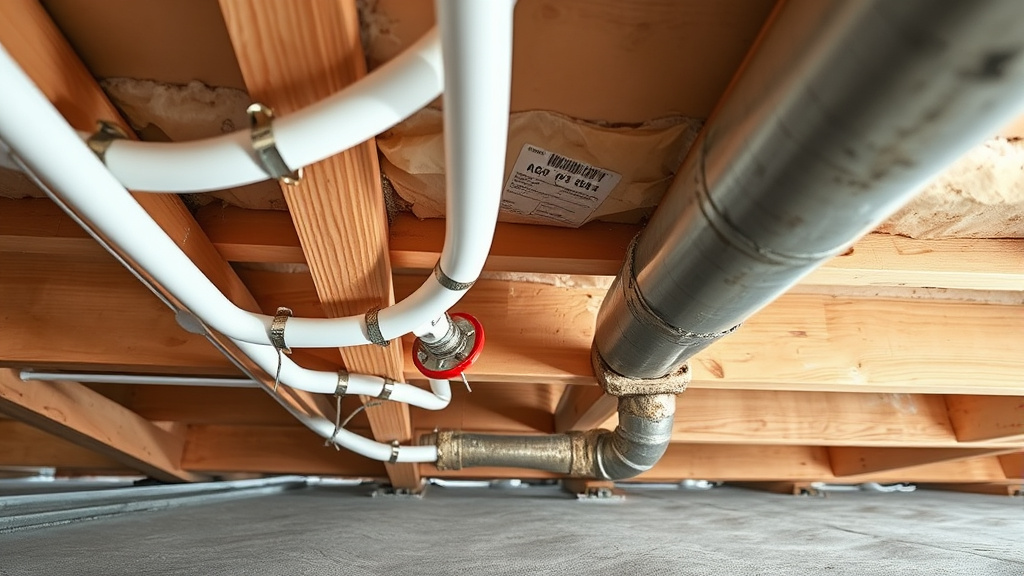
Copper has the longer track record and handles heat without complaint, but it costs more and takes longer to install. PEX is flexible, which is the practical advantage in a retrofit — it can be routed through existing cavities and around framing with far less demolition, and it tolerates a freeze better than rigid pipe. CPVC turns up on some jobs as well. Each has real tradeoffs in cost, longevity, and how much of your house has to be opened up, and weighing one material against another is worth doing before the estimate is signed rather than after.
The layout of the house tends to narrow the choice on its own. A single-story ranch over an accessible crawlspace gives a plumber options that a two-story with finished ceilings does not.
How the work unfolds
A proper estimate starts with someone walking the house — locating the existing runs, checking pressure, looking at the water heater connections and the main shutoff, and finding out which walls and ceilings have to be opened. That walkthrough is what separates a real number from a guess.
Permits come next. Work on a home's water supply is inspected work, and a contractor who treats the permit as optional is telling you something about how the rest of the job will go. From there the new lines go in, usually zone by zone so the house is not without water for the duration. The system is pressure-tested, the inspector signs off, and only then does the drywall get patched — which is the part homeowners consistently underestimate, since finish repair and paint are their own trade.
Timing it around a wet winter
Water gets shut off in stages during the work, so it helps to have a plan for the household rather than discovering mid-week that nobody can wash dishes. Clearing access to walls, closets, and the crawlspace hatch ahead of time saves hours that would otherwise be billed.
Season matters more here than in drier climates. Crawlspace work in the middle of a Puget Sound winter is wet, cold, and slower, and the stretch of clear weather that makes the job pleasant is also when every plumber in the county is booked. Scheduling in the shoulder seasons is usually the difference between choosing your contractor and taking whoever is free.
None of this is an emergency until it is. The advantage of dealing with old supply lines on your own schedule is that you get to compare bids, pick materials deliberately, and plan the disruption — rather than making all three decisions at once with the water shut off and a wet ceiling overhead.